Accelerating scikit-learn: early findings of benchmarks on Intel hardware
 Arthur Lacote
TL;DR:
- We care about the performance and resource use of scikit-learn, and we’re glad that Probabl and Intel collaborate to improve them. The first benchmark results are public.
- The good news: the improvements they drive reach users through new releases, whether they land in scikit-learn (version 1.10 will have some of them) or in other projects of the ecosystem (OpenBLAS, oneDAL, PyTorch, joblib, loky), and not only on Intel hardware.
- If you run scikit-learn on a machine with many cores, the benchmarks show
that it’s often significantly better to use them in the outermost loop
(
GridSearchCV,cross_validate…) rather than in a single model fit.
The Probabl Labs team has been working on the performance of scikit-learn since April 2026, and this post is a first progress update. In June, at VivaTech, Probabl and Intel announced a collaboration to make scikit-learn faster on Intel hardware: Xeon CPUs, Intel GPUs, from high performance data center servers with hundreds of cores down to consumer laptops.
We prioritized data center environments and use cases, where performance directly translates into costs. For instance, if a single fit uses only 4 of the 172 cores, the remaining 168 sit idle unless given other work, such as running multiple fits in parallel. Below, we explain what the benchmarks show, how to make good use of many cores and what we’re now fixing to make a single fit use more of them.
“Enterprises run scikit-learn at scale while performance and cost directly shape what they can build. Our work with Intel is about delivering measurable gains in both, openly and for everyone, so the whole community moves forward together.” —Yann Lechelle, Executive President of Probabl
Where we are after six months
The first goal was to set up benchmarks that tell us, reliably and repeatedly, where and how to improve performance. They live in a public repository, with dashboards that compare implementations, builds and machines. They can also check the impact of scikit-learn PRs before they get merged.
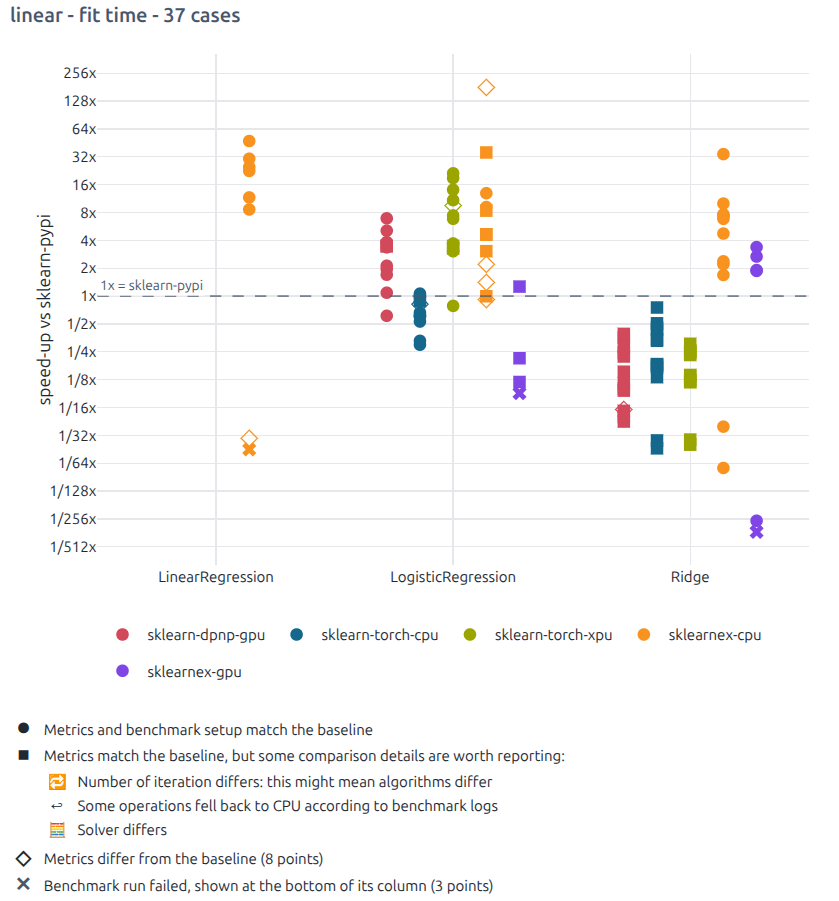
Implementations dashboard on the laptop: speed-up of each implementation over the scikit-learn PyPI wheel, for linear model fits. Each point is one case (estimator, dataset, parameters).
These benchmarks have driven improvements well beyond scikit-learn. Running scikit-learn and its alternatives on real datasets surfaced bugs and slowdowns in other projects. We reported ~20 issues: 11 to scikit-learn-intelex and oneDAL, the others to PyTorch’s XPU backend, OpenBLAS, joblib, loky, narwhals and conda-forge. Some came with a fix, like the three merged in oneDAL.
In scikit-learn itself, the benchmarks showed where the time goes. Some speed-ups are already merged, others are under review: they’re described in What’s next.
Meanwhile, related work landed in scikit-learn and its dependencies: official Intel GPU support through the Python array API in scikit-learn 1.9, threadpoolctl 3.7.0, and thread management in joblib and loky (more at the end of this post).
So far, the value is mostly in knowing where the problems are, and in fixing them where they live, which is sometimes not scikit-learn. All of it happens in the open, in the upstream projects, under their own open source licenses, so every user of these projects benefits, whatever their hardware vendor. The fixes that land in scikit-learn reach users when they upgrade: same API, faster on the hardware they already have.
A short primer on parallelism in scikit-learn
Most of what we found is about how scikit-learn uses the cores of a machine, so here are the basics. The parallelism guide of the scikit-learn documentation has more details.
Outer and inner parallelism. There are usually two levels where work can run in parallel. The outer level runs many independent fits: the candidates of a hyperparameter search, the folds of a cross-validation. The inner level splits a single fit across cores: the trees of a random forest, the histograms of a gradient boosting iteration, a matrix product. Outer parallelism is the easy kind: the fits don’t need to talk to each other, so it scales well as long as there is enough memory. Inner parallelism is harder: the threads of a single fit have to synchronize, often thousands of times per fit.
Three mechanisms. scikit-learn runs work in parallel in three ways, sometimes within the same estimator:
- joblib, controlled by the
n_jobsparameter, runs Python functions in parallel, with two backends:- loky, the default, uses separate processes: that’s how
GridSearchCVorcross_validatefit their candidates and folds. - ‘threading’ uses threads of the same process, which share the data
instead of copying it. But Python’s global interpreter lock (GIL) runs
Python code in only one thread at a time, so threads only help when the
heavy work happens in compiled code, which can release the lock. That’s
the case for the tree building of
RandomForest*andExtraTrees*, written in Cython, which fit their trees in threads.
- loky, the default, uses separate processes: that’s how
- OpenMP parallelizes loops in scikit-learn’s own
compiled code:
HistGradientBoosting*,KMeans, nearest neighbors and pairwise distances, among others. These estimators have non_jobsparameter, and use as many threads as there are logical CPUs by default. - BLAS libraries, such as OpenBLAS or MKL, run the matrix products and decompositions that NumPy and SciPy call. Linear models spend most of their time there. They are also multi-threaded by default.
The OpenMP and BLAS threads aren’t set through scikit-learn’s API, but with
environment variables (OMP_NUM_THREADS, OPENBLAS_NUM_THREADS,
MKL_NUM_THREADS) or, from Python, with
threadpoolctl:
from threadpoolctl import threadpool_limits

# joblib: n_jobs sets the number of workers of the outer loop
search = GridSearchCV(RandomForestClassifier(), param_grid, n_jobs=8)

# OpenMP and BLAS: an environment variable set before starting Python,
#   OMP_NUM_THREADS=4 python train.py
# or threadpoolctl, from Python
with threadpool_limits(limits=4, user_api="openmp"):
    HistGradientBoostingClassifier().fit(X, y)
Everything else runs on a single core: Python code, input validation, copies and most NumPy operations outside of BLAS, and the steps of an algorithm that depend on each other, like the iterations of a solver or of gradient boosting. These sequential parts set a floor that more cores can’t lower.
Overhead. Parallelism has a cost: waking threads up, splitting the work and merging the results take time, and this cost grows with the number of threads. When each parallel chunk of work is small, more threads can make a fit slower.
Oversubscription. This is the other trap: running more threads than
cores, for instance, on a 16-core machine, 16 outer workers that each start 16
OpenMP threads: 256 threads for 16 cores. The threads then compete for the
cores, and the time goes into switching between them. To prevent it, joblib
limits the OpenMP and BLAS threads of its worker processes to
cpu_count() // n_jobs. Starting with the next joblib release, it will also
limit the threads that joblib itself starts inside a worker, like those of a
random forest fit
(joblib#1825).
Benchmark results and takeaways
Unless stated otherwise, the numbers below come from two machines provided by Intel: a two-socket server with Intel Xeon 6787P CPUs (172 cores in total, 344 with hyper-threading, 500GB of RAM), and a laptop with an Intel Core Ultra X7 358H CPU (16 cores) and its integrated Arc B390 GPU. How the benchmarks work is described further down.
scikit-learn-intelex is the most consistently fast option on CPU
scikit-learn-intelex
(sklearnex) replaces some scikit-learn estimators with implementations from
the oneDAL library (both are now part of the UXL Foundation), and keeps the
scikit-learn API. Among everything we
benchmarked, it’s the option that speeds up the most cases on CPU. Tree-based
models and KMeans gain the most: KMeans fits are ~3x faster and never
slower than with scikit-learn 1.9. Linear models gain less. For KMeans, the
speed-ups coming in scikit-learn 1.10 make scikit-learn competitive with
sklearnex up to ~16 to 24 cores (see What’s next).
It usually makes much better use of many-core machines. With scikit-learn, random
forests and extra trees fit ~2x to 4x faster on the 172-core server than on the
laptop. With sklearnex, they fit ~10x to 15x faster.
Part of the tree speed-up comes from binning: sklearnex uses
max_bins=256 by default, which roughly doubles or triples the fit speed-up.
When both libraries use the same exact-split algorithm, the gap is much
smaller. This is a strong argument for adding binning to scikit-learn’s
trees, see What’s next.
The caveat is that sklearnex only supports
a subset of estimators and parameters
(it falls back to scikit-learn for the rest), and doesn’t always behave exactly like scikit-learn. Running it on real
datasets, with missing values, categorical features and multiclass targets,
surfaced a number of bugs. I reported 11 issues to
scikit-learn-intelex
and oneDAL, and sent fixes for some
of the tree ones.
The most impactful issues
ExtraTreesRegressorstopped splitting too early (oneDAL#3648, fixed in oneDAL#3649).- Best-first tree growth (
max_leaf_nodes) expands leaves in a worse order than scikit-learn (oneDAL#3771, fixed in oneDAL#3772 and oneDAL#3773). - Tree models crash when
Xhas missing values at predict time but not at fit time (sklearnex#3356, fixed in sklearnex#3357 and sklearnex#3358). - On laptops, multinomial
LogisticRegressionon 4 threads or more stops too early and returns a worse model (oneDAL#3820, with a fix proposed in oneDAL#3912). This needs to be fixed before any performance measurements. - CPU
Ridgeis much slower than scikit-learn whenn_features > n_samples, because it doesn’t use the dual formulation like scikit-learn does (sklearnex#3377, with a fix proposed in oneDAL#3899).
The Intel team has been quick to respond on all of them and fixes are either already merged or on the way for most of them.
Builds matter: for linear models, pick MKL
This is the cheapest speed-up in this post. With conda-forge’s MKL build of scikit-learn, BLAS-bound linear model fits are commonly 1.3x to 2x faster than with the PyPI wheel (Builds dashboard). You don’t need to change any code, only how you install scikit-learn:
conda install -c conda-forge scikit-learn "libblas=*=*mkl"
# or, with pixi
pixi add scikit-learn "libblas=*=*mkl"
It’s also possible to install an MKL build with pip, from Intel’s index. If you stay on OpenBLAS, conda-forge ships it with either pthreads or OpenMP threading, and the builds dashboard compares both.
The PyPI build had a much bigger problem with
LogisticRegression, a typical case of the
overhead described above.
On the laptop, it fitted up to ~10x slower than with the conda-forge builds,
and got slower as soon as it ran on more than one logical CPU: the OpenBLAS
bundled with scipy 1.18 wakes all its threads for the tiny triangular solves
inside L-BFGS-B, and synchronizing them costs much more than the work itself.
A more recent OpenBLAS fixes it. It ships with scipy 2.0, and should be
backported to 1.18.2
(scipy#26193).
A smaller one, but in scikit-learn itself: ExtraTrees fits were ~25% slower
on conda-forge than with PyPI. conda-forge compiles against the headers of an
old glibc (2.17), where isnan is a macro that calls a glibc function instead
of the compiler builtin. So every isnan in the hot loops of the trees became
a real function call
(analysis in #34869).
#34876 replaces it
with x != x and will be in the next release. Other conda-forge packages with
isnan in a hot loop are probably affected too, so I
reported it to conda-forge.
Many-core servers are built for many fits at once, not for one
A many-core server is built to run many things at once. Hyperparameter searches are where it pays off: with many fits in parallel, the server gets through tree-based model fits ~10x to 15x faster than the laptop, close to the ratio of physical cores (172 vs 16). Linear models gain less, from ~2x to ~12x depending on the dataset.
A single fit is a different story: the 172-core server is often no faster
than the 16-core laptop. Ridge,
LogisticRegression and KMeans stop
scaling after a few cores. With the same number of cores, both machines fit
these models in about the same time. With all of them, which is the default,
the server can even be slower: up to ~3x for a Ridge fit in our
core-count scalability dashboard.
Only random forests and extra trees, whose trees are built independently,
fit faster on the server. Some of this is inherent: many algorithms are hard
to split across many cores, and past a few dozen cores, memory bandwidth and
synchronization costs eat into the gains. Some of it can be improved, and that’s
what software optimization work is about.
So if you work on a machine with many cores, parallelize the outer loop
(hyperparameter search, cross-validation) instead of counting on a single fit
to use all the cores, by setting n_jobs on the search:
search = GridSearchCV(LogisticRegression(), param_grid, n_jobs=32)
search.fit(X, y)
On a 172-core server, that’s the difference between using most of the
machine and using a few percent of it. You don’t need to set the inner
threads yourself: joblib caps the OpenMP and BLAS threads of each worker to
cpu_count() // n_jobs, so the fits don’t oversubscribe the machine.
The
hyperparameter search scalability dashboard
shows this on the Xeon server. With n_jobs=1, the search runs its fits one
after the other, and each fit tries to use all 172 cores, with little
success. With n_jobs=172, it runs 172 fits at once, one per core. For a
LogisticRegression on a small dataset, the second way
gets through the fits ~40x faster. A Ridge on the 5 million rows
of SUSY gains less, ~8x, and little past ~40 workers: its fits likely compete
for memory bandwidth.
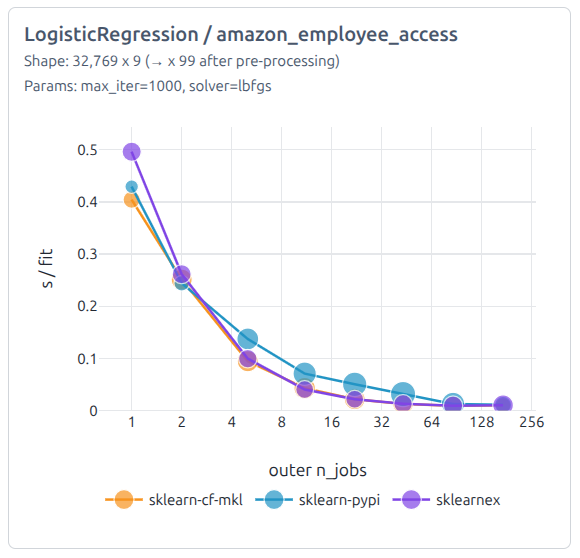
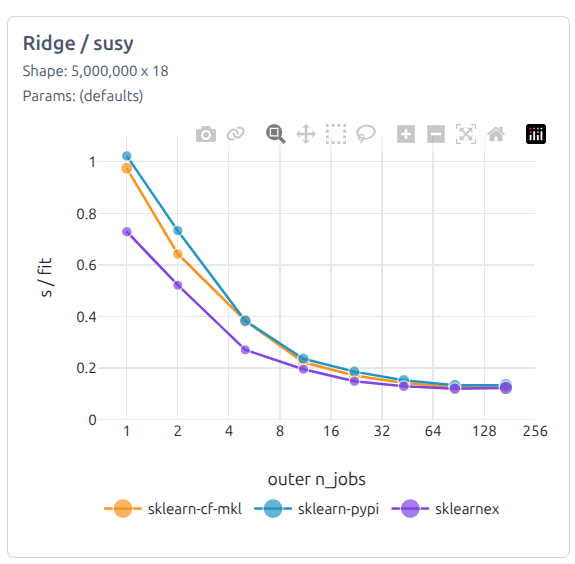
Hyperparameter searches on the Xeon server: wall time of the search divided
by its number of fits, vs the outer n_jobs (log scale), for three
implementations. The marker size is the CPU load.
HistGradientBoosting: the optimal number of threads depends on the data
This is the clearest example of a thread-management problem. On the Xeon
server, the optimal number of threads for a HistGradientBoosting* fit depends
on the shape of the data: 1 thread for the smallest workloads, 4 to 8 for
medium ones, 16 to 64 for the largest. Past that point, fits get slower: every workload is 2x to 30x slower
on 128 or 172 threads than on its optimal thread count. And by default, HGB uses
all the cores of the machine.
Until the fix lands, you can cap its OpenMP threads with threadpoolctl:
with threadpool_limits(limits=8, user_api="openmp"):
    HistGradientBoostingClassifier().fit(X, y)
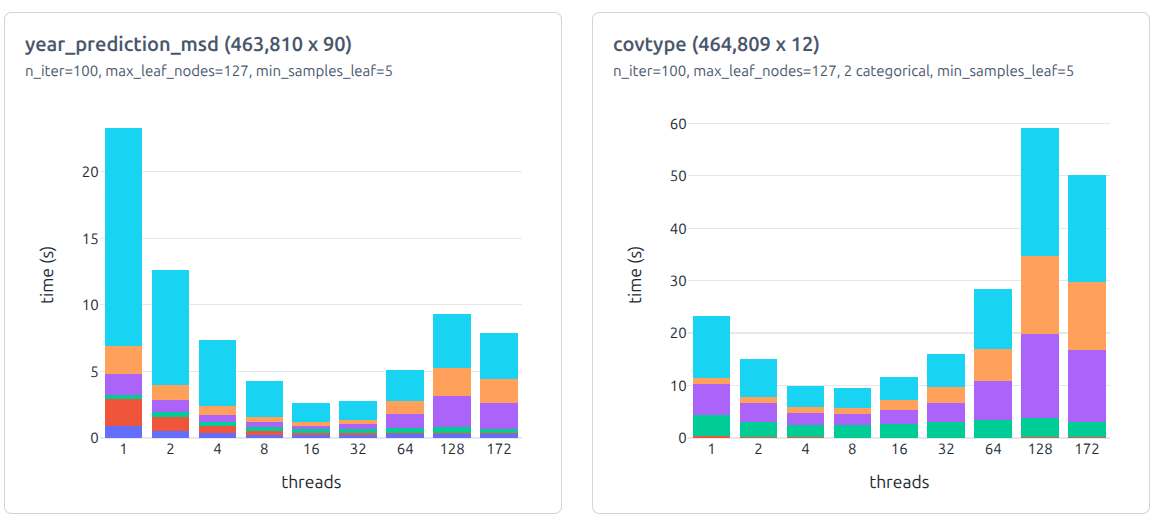

HistGradientBoosting fit time on the Xeon server, split by phase, for two
real datasets of ~500k samples. One can observe that fit duration decreases
when going from 1 to 8 or 16 threads depending on the shape of the data, and
beyond that point thread scheduling overhead dominates to the point of
degrading performance, especially on many-core hosts.
In short, a single HGB fit typically runs thousands of small OpenMP parallel regions whatever the size of the data, and with many threads, starting a region might cost more than the work inside it. That cost also depends on the OpenMP runtime and settings, which differ between builds. On the laptop, the conda-forge builds get worse slowdowns because they use a more recent OpenMP runtime than the PyPI wheels. I wrote down what I know about it in #34764.
#34935 implements different strategies to better utilize OpenMP threads. In our benchmarks, it gives 2x to 10x speed-ups for small and medium datasets on the server and on laptops with conda-forge-like OpenMP settings. It’s still under review, and the full story will get its own blog post.
Other issues found and fixed along the way
- An OpenBLAS crash
with
KMeanson the 344-logical-CPU server, fixed recently by OpenBLAS#6105, which will ship in the next OpenBLAS release. - Wrong physical core counts in loky under CPU affinity.
- In PyTorch’s Intel GPU backend, a
50x to 80x slowdown in
matmuland bad precision for float64 matrix-vector products.
How the benchmarks work
We needed benchmarks to profile realistic cases, to measure the impact of
scikit-learn PRs before merging them, and to show users the trade-offs
between implementations, builds and machines. Existing benchmarks answered
other questions. For instance, the
scikit-learn workload of the Phoronix Test Suite,
which many hardware reviews use, still runs the benchmark scripts of
scikit-learn 1.2.2, where HistGradientBoosting gets up to ~20x
slower on a 64-core server than on a laptop: that says more about thread
management than about the hardware. Intel’s
scikit-learn_bench was a
better starting point: our suite started as a fork of it, before
growing into its own project.
The suite fits and predicts with a restricted set of important estimators:
- Linear models:
LinearRegression,RidgeandLogisticRegression - Tree-based models:
RandomForest*,ExtraTrees*andHistGradientBoosting*(classifiers and regressors) - Clustering:
KMeans
They run on synthetic datasets covering a matrix of shapes, and on around 15 public real datasets (covtype, SUSY, Ames housing, KDD Cup 2009…) with realistic preprocessing and tuned hyperparameters. Each case runs in several environments, all locked with pixi:
- Builds of scikit-learn: the PyPI wheel, and conda-forge with MKL or with OpenBLAS.
- scikit-learn-intelex, on CPU and Intel GPU.
- Python array API backends: PyTorch (CPU, Intel XPU, NVIDIA CUDA, Apple MPS), dpnp and CuPy.
Comparing fairly is the hard part: sklearnex random forests bin the
features by default, solvers stop after different numbers of iterations, and
some backends silently fall back to scikit-learn. So each run records its
metrics, setup, hardware and software stack, and the dashboards flag every
case where the setup or the metrics differ from the baseline.
The results are split into dashboards that each vary one thing:
implementations,
builds,
hardware,
core-count scalability,
hyperparameter search scalability,
and a
breakdown of HistGradientBoosting fits
by phase. Every point can be hovered, and links to the exact timings, metrics
and warnings.
The same machinery also benchmarks scikit-learn pull requests before they get
merged. This is for instance how I measured the speed-up of the new k-means++
initialization of KMeans
(example).
What’s next
Here are our priorities for the next months, in order, and where each one stands. The biggest pieces will get their own blog post.
HistGradientBoosting scalability. Get
#34935 (see above)
merged, and make the tools developed for it available in threadpoolctl.
KMeans. Looking at why sklearnex is so much faster on KMeans led to
two PRs, the most promising speed-ups so far. On the Xeon server, the
k-means++ initialization took most of the fit time.
#35140, merged and
coming in scikit-learn 1.10, makes it ~8x to 20x faster in our benchmarks. The Lloyd
iterations that follow stopped scaling at ~16 threads, because of costs that
grow with the number of threads.
#35193, still under
review, removes them, and makes the iterations several times faster on the
server. Together with
OpenBLAS#6105, they
should also close a long-standing issue,
#17334. This
story might get its own blog post.
Documentation. Many of the findings above (which build to install or how to set threads) belong in the performance and parallelism guides of the scikit-learn documentation, with a section for Intel users, from laptops to data center servers.
Trees. Binning is one of the main reason sklearnex’s random forests are faster,
and the next big item is to add it to scikit-learn’s RandomForest* and
ExtraTrees*. In parallel, I’m experimenting with faster sorting for exact
splits: SIMD sort and radix sort. Radix sort gives very promising results.
I’m also experimenting
with free-threaded Python: with a lower-overhead thread pool, forest fits on
the 172-core Xeon server get ~2.5x faster (median) than with the GIL.
Encoders. Profiling a typical tabular pipeline showed OneHotEncoder and
OrdinalEncoder could take a surprising share of the time in some settings.
Itamar Turner-Trauring sped up unique value counts for strings
(#34386). I made
the encoders work on F-ordered data
(#34392). The next
step, #34678, tries
to leverage the internal encoding of pandas categorical columns, but getting
every edge case to behave exactly as on main turned out to be complex, so
it’s paused for now.
Linear models. Copies of X can take a large share of the fit time of
linear models: they are slow, single-threaded and double the peak memory,
while the rest of the fit runs in multi-threaded BLAS. So we’re looking for
the copies that can be avoided.
Benchmarks.
- More estimators:
PCA,LogisticRegressionCVandRidgeCV. - XGBoost, LightGBM and CatBoost, to compare
HistGradientBoosting*with them systematically. - Discrete Intel GPUs, and more CUDA results to compare them with.
- A new version of the Phoronix scikit-learn workload, based on a subset of these cases, that we’d like to create in collaboration with the Phoronix maintainers.
Threads and the Python array API. These are related workstreams. Itamar Turner-Trauring (Quansight) and Olivier Grisel (Probabl) work on how scikit-learn and its dependencies manage threads, in particular for free-threaded Python: threadpoolctl 3.7.0 can now set thread-local limits for MKL and OpenBLAS, loky detects physical cores better on many-core machines, and the next joblib release will be thread-safe and protect against nested oversubscription. Python array API support also keeps progressing, with an Intel GPU CI in scikit-learn-intel-workflow.
If you run scikit-learn on many-core machines, or see a result that doesn’t match your experience, please open an issue. I’m particularly curious about workloads where a single fit on many cores matters to you: so far, most of our cases suggest that the outer loop is where the cores should go.
Acknowledgements
This work is funded by Intel as part of its collaboration with Probabl. The infrastructure work on threading parallelism in scikit-learn is also supported by NASA through the ROSES grant 80NSSC25K7215, “Ensuring a fast and secure core for scientific Python”.
Thanks to Olivier Grisel for the guidance and the reviews, to Itamar Turner-Trauring for the encoders and threading work, and to the scikit-learn-intelex and oneDAL maintainers at Intel for providing the hardware, and for their quick answers and fixes, in particular David Cortes.